
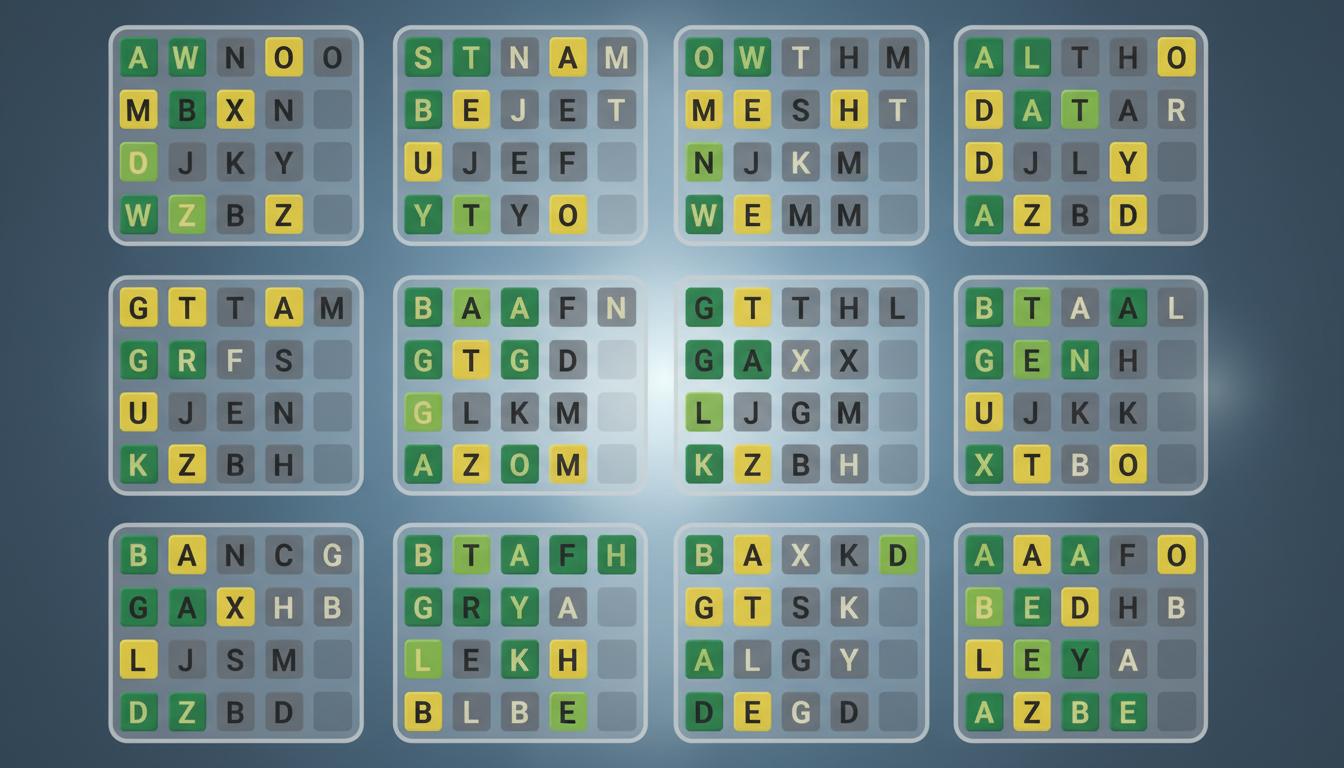
If Wordle feels like a warm-up, sedecordle is the full workout. It asks you to solve sixteen five-letter words at the same time, all with the same set of guesses. It’s quick to learn, tough to master, and perfect for a bus ride from Upper Hutt to Wellington or a quiet moment with a flat white. This guide explains what sedecordle is, how it works, the different ways to play, smart strategies, pros and cons, and answers to common questions—so you can jump in and actually enjoy the challenge.
What is
Sedecordle is a fan-made Wordle variant where you solve 16 hidden five-letter words at once. Every guess you enter applies to all 16 boards, revealing coloured feedback for each board. You usually get 21 guesses to finish all boards. The format is familiar—green for correct letters in the right spot, yellow for correct letters in the wrong spot, and grey for letters not in the word—but the scale changes the game completely.
Unlike classic Wordle’s quick daily burst, sedecordle stretches your pattern-spotting and letter-coverage skills. It rewards calm thinking, steady elimination, and good note-taking (mental or otherwise). Many sites offer a Daily sedecordle plus an endless practice mode, so you can test yourself without waiting for tomorrow.
How it works
The core mechanics
You start with sixteen blank 5×6-style grids arranged in a scrollable layout. Enter a valid five-letter word. That single guess is evaluated across every grid. You’ll see different colours appear on different boards based on each board’s hidden word. Keep guessing within the shared limit—typically 21 total guesses—to reveal enough letters to solve all words.
Colour meanings
- Green: Letter is correct and in the right place.
- Yellow: Letter is in the word but in a different place.
- Grey: Letter is not in the word (for that board).
Shared guesses, shared pressure
Because every guess hits every board, you can’t waste turns. You balance two goals: making progress on the toughest boards and locking in solutions on the easy ones. Spreading early guesses to cover common letters (vowels, R, S, T, L, N) pays off later when you have to untangle tricky endings like -ING, -AL, or doubled letters.
Daily vs practice
- Daily sedecordle: One new set of 16 words per day. Your result can be shared as a spoiler-free grid of coloured squares.
- Free/practice mode: Unlimited puzzles on demand. Great for building strategy and warming up before the daily.
Devices and accessibility
- Works in a browser on desktop, tablet, and mobile. No download needed.
- Most versions support dark mode, colour-blind palettes, and simple keyboards.
- Data use is tiny—handy if you’re on mobile data while out and about in NZ.
Types / examples
Main ways to play sedecordle
- Daily sedecordle: The standard daily challenge with a single puzzle for everyone that day.
- Free/practice sedecordle: Unlimited puzzles with the same rules as the daily. Use this to try new openers or test letter-coverage sets.
Related word-multiples (for context)
- Wordle: 1 board, 6 guesses—fast and casual.
- Quordle: 4 boards, shared guesses—good mid-tier step up.
- Octordle: 8 boards—harder, more juggling.
- Sedecordle: 16 boards—deep strategy, longer playtime.
- Duotrigordle: 32 boards—marathon mode for puzzle diehards.
Example flow (short)
Open with a coverage word like “ARISE”. Greens and yellows light up across several boards. Follow with “COUNT” to probe O, U, C, N, T. Now you’ve touched most common vowels plus top consonants. Switch to targeted guesses on the toughest boards, using precise words (not random stabs) to confirm letters and positions.
Comparison of popular variants
| Game | Boards at once | Guess limit | Typical time | Who it suits |
|---|---|---|---|---|
| Wordle | 1 | 6 | 1–5 minutes | Quick daily hit |
| Quordle | 4 | 9 | 5–10 minutes | Step up in difficulty |
| Octordle | 8 | 13 | 10–15 minutes | Balanced challenge |
| Sedecordle | 16 | 21 | 15–30+ minutes | Strategic, patient solvers |
| Duotrigordle | 32 | 37 | 30–60+ minutes | Long-form puzzle fans |
Pros and cons
Pros
- Deep strategy: Shared guesses create real trade-offs and planning.
- Great value: One puzzle can fill a full coffee break or commute.
- Skill builder: Improves letter-frequency intuition and pattern spotting.
- Flexible: Daily sedecordle for a once-a-day fix; practice mode for drills.
- Low friction: Runs in a browser, light on data, easy to share results.
Cons
- Time sink: Sixteen boards can be a lot if you only wanted a two-minute game.
- Steeper learning curve: Random guesses get punished fast.
- Word list quirks: Expect mostly general English. NZ-specific spellings and te reo Māori kupu are rarely answers.
- Visual load: Many grids at once can feel busy, especially on smaller phones.
How to use or choose
How to play sedecordle (step by step)
- Open a sedecordle site on your browser (desktop or mobile).
- Pick Daily or Free/Practice mode.
- Enter a strong starter (e.g., “ARISE” or “AUDIO”). Press Enter.
- Scan all 16 boards. Note where you have multiple greens or promising yellows.
- Use a second coverage word (e.g., “COUNT” or “SLATE”, depending on your first guess) to test common consonants.
- Target tough boards. Choose guesses that confirm placements rather than fishing blindly.
- Lock in easy solves when they are one letter away to reduce cognitive load.
- With 5–8 guesses left, stop broad coverage and focus on finishing each remaining board efficiently.
- Share your grid if you like. Then try practice mode to refine tomorrow’s approach.
Smart strategies for better results
- Plan a two-word opener: Pair a vowel-rich word with a consonant-rich one. Examples: ARISE + COUNT, AUDIO + TURNS, SLATE + ROUND.
- Track letter bans: If “H” looks dead across most boards, avoid it in future guesses unless a specific board suggests it.
- Solve by information density: Focus first on boards with 2–3 greens; they give you quick wins and free mental space.
- Mind duplicates: Words like “SHEEP” and “FUNNY” show how doubles can mislead. Use guesses that can confirm repeats (e.g., swapping positions).
- Use endings smartly: Test common finals (-ER, -ED, -ING, -LY) with informative guesses rather than straight stabs.
- Stay calm in the endgame: With three or four boards left, stop experimenting. Choose the most constrained board and finish it before moving on.
How to choose the right variant for your day
- Short break (under 5 minutes): Wordle or Quordle.
- Decent pause (10–20 minutes): Octordle or sedecordle.
- Long downtime (30+ minutes): Sedecordle or Duotrigordle.
- Skill practice: Sedecordle practice mode to hone openings and endgame discipline.
NZ-specific tips
- Language quirks: Most sedecordle answer lists lean to general or US spelling. Favour neutral spellings in guesses.
- On the go: Use dark mode on bright days and colour-blind mode if needed. Both help with contrast on mobile.
- Data and battery: It’s lightweight, but closing background tabs and lowering screen brightness will keep your phone happy on long trips.
FAQ
What exactly is sedecordle?
It’s a Wordle-style browser game where you solve 16 five-letter words at once using a shared pool of guesses, typically 21. One guess updates every board.
Is sedecordle free?
Yes. Most versions are free to play in your browser. Some sites show ads to cover costs.
Where can I play sedecordle?
Search “sedecordle” in your browser and choose a reputable site. You can play on desktop, tablet, or mobile without installing an app.
Does sedecordle have a daily puzzle?
Yes. There’s usually a Daily sedecordle with one set of 16 words per day, plus a Free or Practice mode for unlimited play.
What time does the daily sedecordle reset in New Zealand?
It resets once every 24 hours. Most implementations follow your device’s local time, so it typically rolls over at midnight in your time zone.
Are NZ spellings or te reo Māori words included?
Sedecordle answer lists tend to use general English and rarely include New Zealand spellings or te reo Māori kupu as answers. You can usually guess them, but they’re unlikely to be solutions.
Is there an app?
Most sedecordle versions are web-based. Some third-party apps exist, but the browser versions are the most widely used and easiest to access.
Can I play with friends?
You can race the daily puzzle separately and compare results, or screen-share on a call and solve together. The share grid makes it easy to show your outcome without spoilers.
Any tips for beginners?
Use a two-word opener to cover common letters, then switch to targeted guesses. Avoid random words. Solve the easiest boards first and leave experiments for the ones with the least information.
How hard is sedecordle compared to Wordle?
Much harder. Managing 16 boards with shared guesses demands planning. That said, a good opening strategy and calm endgame make it very achievable.
Can I change colours for colour-blindness?
Many sedecordle sites offer a colour-blind mode with higher-contrast palettes. Look for settings or a small palette icon.
Do proper nouns appear as answers?
No. Like Wordle, proper nouns are typically excluded from answer lists, though they may be accepted as guesses depending on the site.
How do I track letters efficiently?
Rely on the on-screen keyboard highlights and scan boards where feedback clusters. If a letter is grey across many boards, avoid it unless a particular board strongly suggests it.
What’s a good starter for sedecordle?
Common pairs include ARISE + COUNT, AUDIO + TURNS, or SLATE + ROUND. They quickly cover vowels and high-frequency consonants, giving you strong early information.
Why do I run out of guesses at the end?
Over-exploring in the midgame is the usual cause. After two broad coverage words, switch to targeted solves and bank quick wins to avoid burning turns.
Is sedecordle suitable for kids?
Yes, if they enjoy word puzzles. The difficulty comes from juggling many boards, not from content. Playing together can be a fun family challenge.
Sedecordle turns a simple guessing game into a thoughtful routine. With a sensible opener, steady targeting, and a calm finish, you’ll go from scattered colours to sixteen satisfying greens—no drama, just good, clean wordplay.