
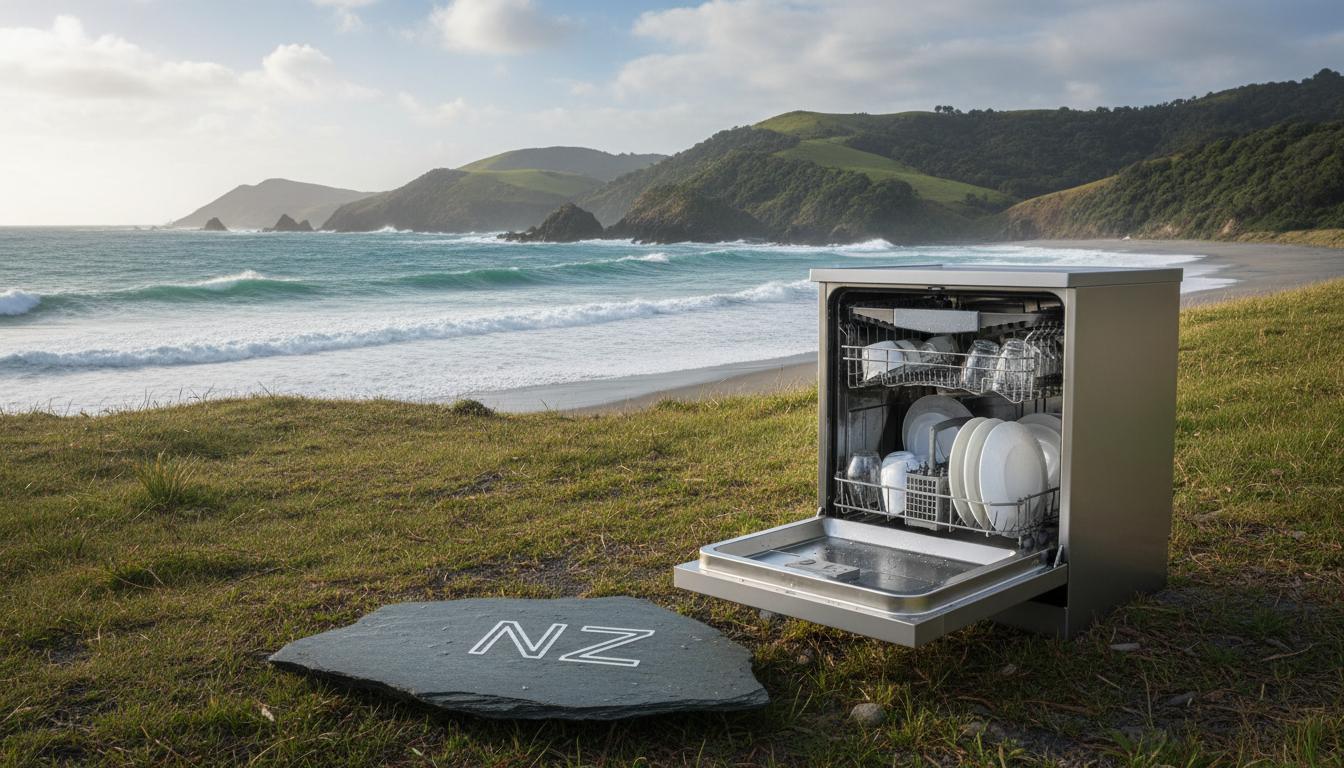
Shopping for a dishwasher in New Zealand should feel simple, not stressful. This guide cuts through jargon and localises what matters for Kiwi kitchens. You’ll learn how dishwashers work, the main types you’ll find in NZ stores, what to look for before you buy, and how to get the best results once it’s installed. If you’re searching for “dishwasher NZ” advice that’s clear, current, and useful, start here.
What is
A dishwasher is a kitchen appliance that cleans dishes, cookware, and cutlery using pressurised water, detergent, and heat. In NZ, the most common size is a 60 cm-wide under-bench unit that slides beneath your benchtop. You’ll also see slimline 45 cm models, benchtop units for small spaces, fully integrated models that hide behind a cabinetry panel, and Fisher & Paykel’s unique DishDrawer units.
Standard NZ dimensions and fit notes:
- Width: 598–600 mm (standard), 448–450 mm (slimline)
- Height: 820–870 mm adjustable to suit benchtops
- Depth: 570–600 mm (allow extra for hoses and ventilation)
- Water: Typically cold feed; hot connection only if the manufacturer allows
- Power: Standard NZ 230–240 V outlet on a dedicated circuit (check manual)
Look for the AU/NZ Energy Rating Label on the front or product page. Many models also display a water rating (WELS) label commonly seen across Australia and increasingly used by NZ retailers.
How it works
Dishwashers don’t “hose” your dishes; they recirculate a small volume of water under pressure for targeted cleaning. Here’s the simple flow:
- Fill: The machine takes in a set amount of water.
- Heat: A hidden or inline heater brings water to the right temperature.
- Wash: Spray arms rotate, blasting water and detergent to remove soil.
- Filter: Food particles are trapped and flushed out later.
- Rinse: Fresh water removes detergent residue.
- Dry: Condensation, fan-assisted drying, auto-door opening, or mineral-assisted systems (in some premium EU models) remove moisture.
Modern “Auto” programs use sensors to check how dirty the load is, then adjust time, temperature, and water use. Eco cycles run cooler and longer to save energy. A sanitize or Hygiene cycle uses higher temperatures to reduce bacteria.
Detergent options include tablets, powder, and gel. Rinse aid improves drying and helps prevent spots. Some European-style models also have a salt compartment to soften very hard water; use it only if your manual recommends it for your local water hardness.
Types / examples
Standard 60 cm under-bench (built-in or freestanding)
The NZ default. Best overall capacity and efficiency. Common brands include Bosch, Fisher & Paykel, Miele, Beko, LG, Samsung, Electrolux, Smeg, and ASKO.
Fisher & Paykel DishDrawer (single or double)
Designed in New Zealand. Two independent drawers (or a single drawer) let you run small loads without bending down. Great for busy households or smaller, frequent loads.
Slimline 45 cm
Narrow footprint for tight kitchens or apartments. Slightly smaller capacity but still handles daily dishes for 1–3 people.
Benchtop/compact
Sits on the bench and connects to a tap or a fixed water line. Good for renters, studios, or baches with limited space.
Integrated (panel-ready)
Hidden behind a cabinet door for a seamless look. Popular in renovations and new builds where design continuity matters.
Comparison: common dishwasher NZ options
| Type | Typical Capacity | Water Use (Eco) | Noise | Indicative Price (NZD) | Best For | Notes |
|---|---|---|---|---|---|---|
| 60 cm Standard | 14–16 place settings | 8–12 L/cycle | 42–50 dB | $700–$1,800+ | Most Kiwi homes | Strong value, widest model choice |
| DishDrawer (Double) | 2 × 6–7 place settings | ~6–7 L per drawer | 43–47 dB | $1,800–$3,500 | Frequent small loads | Run one or both drawers independently |
| Slimline 45 cm | 9–10 place settings | 8–11 L/cycle | 45–49 dB | $800–$1,400 | Small kitchens | Narrower racks; check tall plate fit |
| Benchtop | 4–6 place settings | 6–9 L/cycle | 49–55 dB | $400–$800 | Renters, studios, baches | Needs sturdy bench and tap access |
| Integrated 60 cm | 14–15 place settings | 8–12 L/cycle | 42–48 dB | $1,400–$3,000+ | Design-led kitchens | Requires a custom cabinet panel |
Pros and cons
Pros
- Water and energy savings versus handwashing when used on Eco with full loads.
- Cleaner and more hygienic, thanks to hotter water and better rinsing.
- Saves time and bench space; fewer dirty dishes sitting around.
- Modern units are quiet, good for open-plan living.
- Gentler on glassware and knives than sink scrubbing.
Cons
- Upfront cost and installation requirements.
- Eco cycles are longer; quick cycles use more energy/water.
- Plastic items can retain moisture unless you use extra-dry features.
- Needs regular filter cleaning and the right detergent/rinse aid.
- Space constraints in small kitchens (unless you pick slimline/benchtop).
How to use or choose
How to choose the right dishwasher in NZ (step-by-step)
- Measure the space twice: width, height (to underside of benchtop), and depth. Allow room for hoses and door swing.
- Pick a type that fits your home: standard 60 cm, DishDrawer, slimline, integrated, or benchtop.
- Match capacity to your household: 1–2 people (slimline or DishDrawer), 3–5+ people (standard 60 cm).
- Compare Energy Rating Labels (AU/NZ). More stars generally mean lower running costs over time.
- Check water efficiency information. Many NZ retailers list litres per cycle for Eco programs.
- Prioritise noise if you live open-plan. Aim for 39–45 dB for very quiet, up to ~48 dB for acceptable.
- Look for the right racks: adjustable tines, third cutlery rack, tall-stem glass support, and a sturdy lower rack.
- Programs you’ll actually use: Auto, Eco, Quick, Intensive, Delicate/Glass, Half-load, Extra Dry, Sanitise.
- Installation practicalities: hose lengths, power outlet position, and whether a plumber/appliance installer is needed.
- Service and warranty in NZ: check parts availability and local service agents for your brand.
- Total cost of ownership: consider detergents, rinse aid, potential repairs, and expected lifespan (often 7–12+ years).
Smart ways to use a dishwasher in NZ homes
- Scrape, don’t rinse. Remove food scraps but skip running water; modern machines handle light soil.
- Load so water can reach everything: face plates towards the spray, avoid nesting bowls, and keep the spray arms clear.
- Use Eco or Auto for daily loads. Save Intensive for pots or baked-on trays.
- Choose the right detergent for your water and machine. Tablets are simple; powder gives finer control.
- Add rinse aid for better drying, especially on plastic and in cooler climates.
- Run at off-peak times if your power plan supports cheaper overnight or free-hour periods.
- Clean the filter weekly and wipe the door seals. Run a machine cleaner monthly or as needed.
- If your area has hard water and your model supports salt, set the hardness level in the menu and keep salt topped up.
Where to buy a dishwasher in NZ
Major retailers include Noel Leeming, Harvey Norman, Smiths City, Kitchen Things, and Appliance Shed, along with specialist kitchen studios and direct brand stores. For smaller spaces or tight budgets, check benchtop models online. For bargains, look for run-outs and seconds with full warranties. If you buy second-hand (e.g., on Trade Me), factor in age, condition, seals, and missing parts like cutlery baskets or kick panels.
Costs to expect in New Zealand
- Appliance: roughly $700–$1,800 for mainstream 60 cm models; $1,800–$3,500 for premium/integrated or DishDrawer; $400–$800 for benchtop.
- Installation: typically $150–$300 for a straightforward swap-in; more if plumbing, power, or cabinetry needs altering.
- Cabinetry panel (integrated): allow extra for the custom door and fitting.
- Running costs: depend on your tariff and usage. Eco cycles use less power and water per load.
Maintenance essentials
- Filter: Rinse weekly to keep water flowing and odours down.
- Spray arms: Remove and clear jets if you notice poor cleaning.
- Seals: Wipe door gaskets to prevent grime build-up.
- Descale/clean: Use a cleaner monthly or as needed, especially in hard-water areas.
- Hoses: Inspect for kinks or cracks annually; replace if brittle.
- Leave the door ajar after cycles to release moisture and protect cabinets.
FAQ
Does a dishwasher use less water than handwashing in NZ?
Yes, when you run full loads on Eco. Many modern machines use about 8–12 litres per cycle, often less than filling and refilling a sink.
What size dishwasher fits a standard NZ kitchen?
A 60 cm-wide under-bench model is the norm. Check your height (820–870 mm space) and depth (allow for hoses and door angle).
Is a Fisher & Paykel DishDrawer a good idea?
Great if you do smaller, frequent loads or want less bending. For large families, a standard 60 cm with big racks may be simpler and cheaper.
How quiet should I aim for?
Under ~45 dB is whisper-quiet for open-plan living. Up to ~48 dB is usually fine if the kitchen is separated.
Can I connect to hot water?
Only if your manual allows it and the supply temperature meets the spec. Most dishwashers in NZ are designed for a cold feed to ensure proper heating and cycles.
What can’t go in the dishwasher?
Hand-wash: carbon-steel or high-end chef’s knives, wooden boards and handles, non-stick pans (unless marked dishwasher-safe), fine crystal, and insulated mugs or bottles.
How long do dishwashers last?
Commonly 7–12+ years with good care. Regular cleaning and correct detergent extend life.
Who should install it?
Use a licensed plumber or appliance installer for safe water connections, correct drainage loops, and compliance with local requirements.
What features are worth paying for?
Auto program, adjustable racks, third cutlery rack, half-load, Extra Dry or auto-door opening, good filtration, and a clear cycle time display. Wi‑Fi can be handy for notifications and off-peak scheduling.
Where can I find the best “dishwasher NZ” deals?
Watch public holiday sales, end-of-line clearances, and bundle offers during kitchen renos. Compare retailers and ask about price matching and delivery/installation packages.
Final tips for picking the best dishwasher NZ option
- Measure the cavity carefully and confirm hose/power access before ordering.
- Choose the quietest model you can within budget if your space is open-plan.
- Prioritise strong racks and the programs you’ll really use over gimmicks.
- Run Eco or Auto with full loads; it’s cheaper, cleaner, and better for the environment.
- Keep filters and spray arms clean to maintain “as-new” performance.
With the right choice and a few good habits, a dishwasher turns cleanup into a hands-off routine and saves water and power along the way. That’s the kind of everyday upgrade that makes sense in Kiwi homes.